
The best Google Maps scraping tool for most people is the Apify Google Maps Scraper, at $1.50 per 1,000 scraped places with the deepest field coverage of any hosted option.
If you need volume, Bright Data gives you 5,000 records a month free and drops to $1.30 per 1,000 at scale. If you would rather pay nothing at all, the MIT licensed scraper by omkarcloud runs on your own machine.
Every price below was read from the vendor’s own pricing page on 23 August 2026. Where a vendor does not publish a readable price, this guide says so instead of guessing.
Google Maps scrapers compared at a glance
Each tool below leads at something different. Match the row to your actual job rather than picking the top of the list by default.
| Tool | Best for | Starting price | Free tier |
|---|---|---|---|
| Apify Google Maps Scraper | Best overall | $1.50 per 1,000 places | $5 credit monthly |
| Bright Data Google Maps Scraper API | Best at enterprise scale | $1.50 per 1,000 records | 5,000 records monthly |
| Google Maps Scraper | Best free and open source | Free, MIT licensed | Unlimited if self-hosted |
| Outscraper | Best for breadth of Google data | See vendor | See vendor |
| Scrap.io | Best for territory-based lead generation | $35 a month yearly | None advertised |
| Lobstr.io | Best for predictable credit pricing | $20 a month | 100 credits |
| Scrapingdog | Best for developers running many scrapers | $40 a month | 200 credits |
| Octoparse | Best no-code option for non-developers | $69 a month | 50,000 rows monthly |
| PhantomBuster | Best for chaining scraping into outreach | See vendor | Free trial |
1. Apify Google Maps Scraper
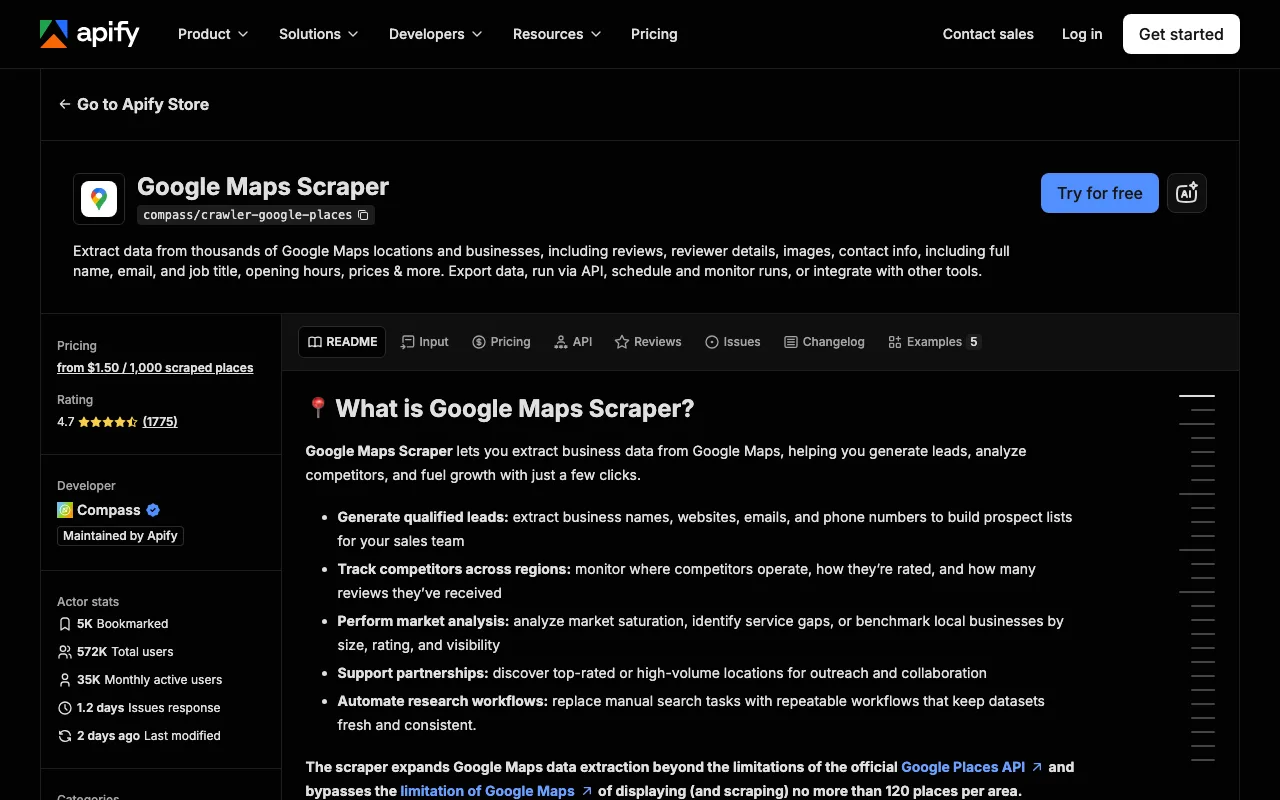
Apify runs the most widely used Google Maps scraper on the market, priced per result rather than per seat.
The actor page shows 34,603 monthly users and a 4.71 out of 5 rating, which is the largest verified user base of anything on this list.
Key features
- Charges “$1.50 / 1,000 scraped places”, so cost scales with output rather than a subscription
- Extracts place ID, category, phone, website, address, coordinates and plus code
- Returns review count and the full review distribution, not just the average rating
- Captures opening hours plus the popular times histogram and live occupancy
- Optional enrichments for emails, job titles and social profiles
- Runs on a schedule and exports to JSON, CSV or an API endpoint
Why it made the list
It is the default recommendation because the per-result price is public, the free tier is enough to evaluate properly, and the actor is maintained rather than abandoned.
Pros
- Lowest published per-record price of the hosted tools at $1.50 per 1,000
- Largest verified user base here at 34,603 monthly users
- Very deep field coverage including popular times and live occupancy
- No subscription needed to start, the free plan includes $5 of usage
Cons
- Compute units are billed on top of results, so heavy runs cost more than the headline
- The platform has a learning curve if you have never used an actor before
- Email enrichment is a paid add-on rather than part of the base price
Visit Apify Google Maps Scraper. Pricing: $1.50 per 1,000 scraped places, on a platform free tier of $5 credit per month.
2. Bright Data Google Maps Scraper API
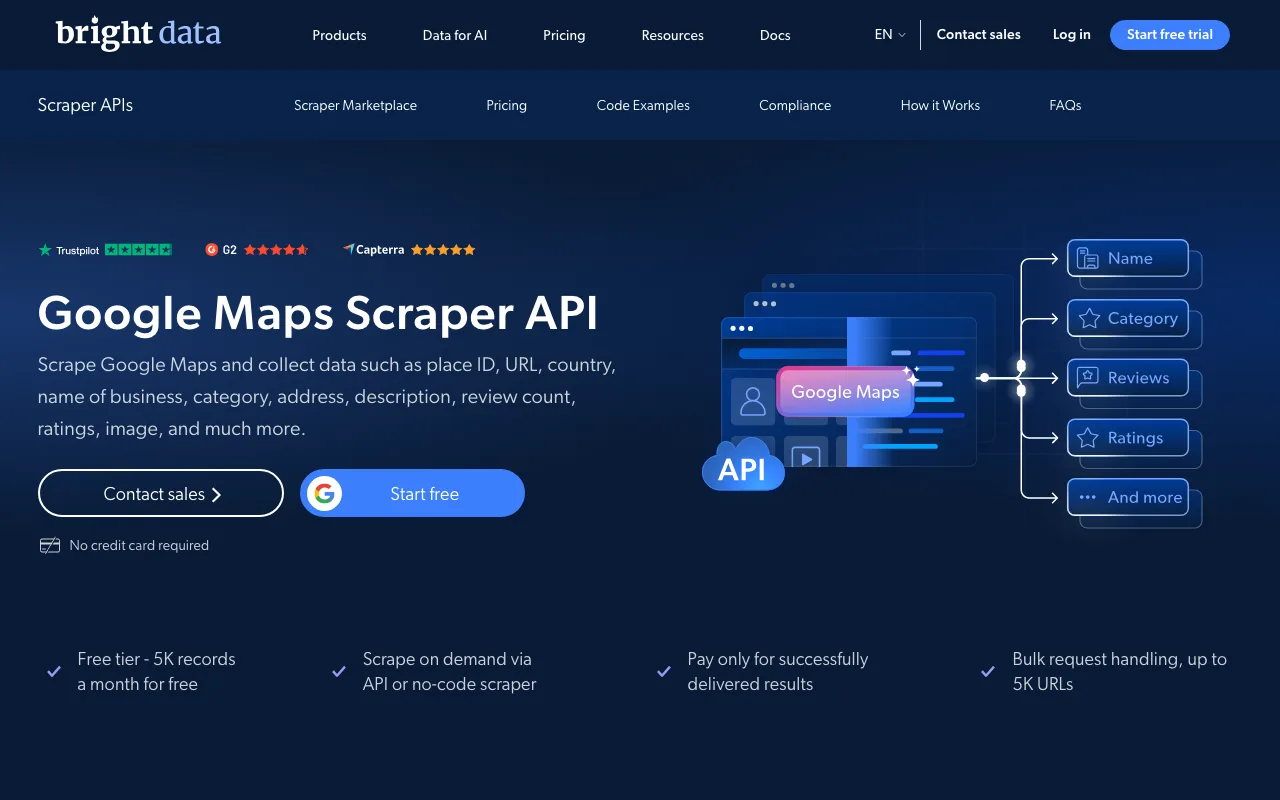
Bright Data is the option built for volume, with a free tier generous enough that most small projects never pay.
Its pricing page states you “pay only for success”, so failed requests do not consume your budget.
Key features
- Free tier of “5K records per month” with no card required
- Pay as you go at “$1.5/1K record”
- Scale plan at “$499/month” with “384,000 records included”, then “$1.3/1K additional records”
- Bulk request handling of up to 5,000 URLs per job
- Unlimited concurrency on paid tiers
- Available as an API or as a no-code scraper
Why it made the list
The volume economics are the best here once you pass roughly 100,000 records a month, and the free tier is the largest of any hosted tool on this list.
Pros
- Largest free tier at 5,000 records a month
- Per-record price drops to $1.30 per 1,000 at scale
- Unlimited concurrency removes the usual throughput ceiling
- Charges only for successfully delivered results
Cons
- The $499 Scale plan is a big jump from pay as you go
- The platform is broad, so the Maps scraper is one product among many
- Aimed at teams, which shows in the sales-led onboarding
Visit Bright Data Google Maps Scraper API. Pricing: Free 5,000 records a month, then $1.50 per 1,000 records, or $499 a month for 384,000 records.
3. Google Maps Scraper by omkarcloud (Botasaurus)
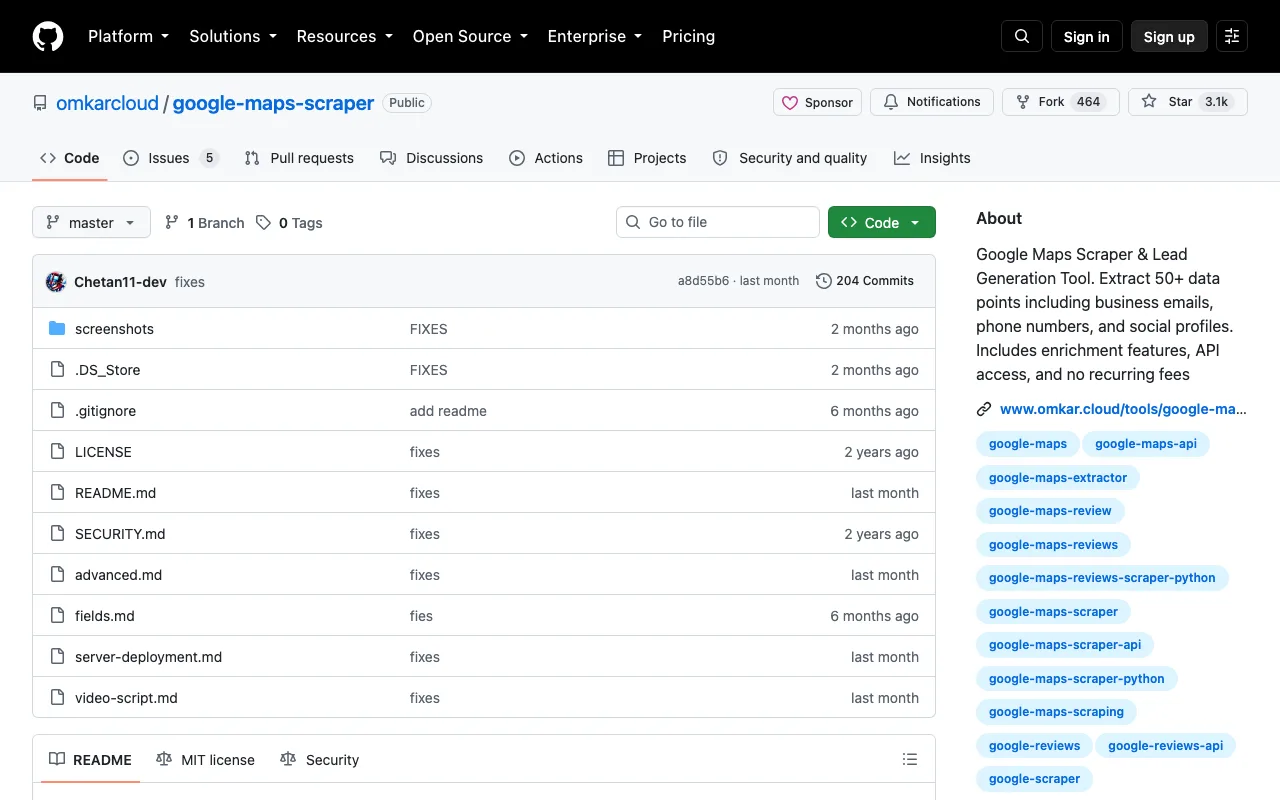
This is the most popular Google Maps scraper on GitHub, MIT licensed, and it runs on your own machine.
It is built on the Botasaurus framework and ships as a desktop app for Mac, Windows and Linux, so there is no per-record meter running.
Key features
- MIT licensed with 3.1k GitHub stars
- Extracts “50+ data points” including name, phone, website, email, social profiles, ratings and reviews
- Desktop builds for Mac, Windows, Ubuntu/Debian and Fedora/CentOS/RHEL
- Ships a built-in API, an npm package and a Python library
- Search strategies include Fast, Fastest, Detailed, Zoom levels and Geolocation
- Typical yield of “100 to 1,000+ results” per search, with “10,000+” per city on the Detailed and Zoom 18 strategies
Why it made the list
Nothing else here gives you unlimited local extraction for nothing, and the review extraction is unusually complete for a free tool.
Pros
- Free and MIT licensed if you self-host
- No per-record billing, so large pulls cost only your own compute
- Deployable to your own AWS or GCP box via the built-in API
- Deep review extraction, which most cheap tools skip
Cons
- You own the maintenance, the proxies and the blocking problems
- The Detailed and Zoom strategies take significantly longer to run
- Hosted convenience costs $16 or $48 a month if you would rather not self-host
Visit Google Maps Scraper. Pricing: MIT licensed and free to self-host, 200 searches a month on the hosted free tier, $16 or $48 a month for more.
4. Outscraper
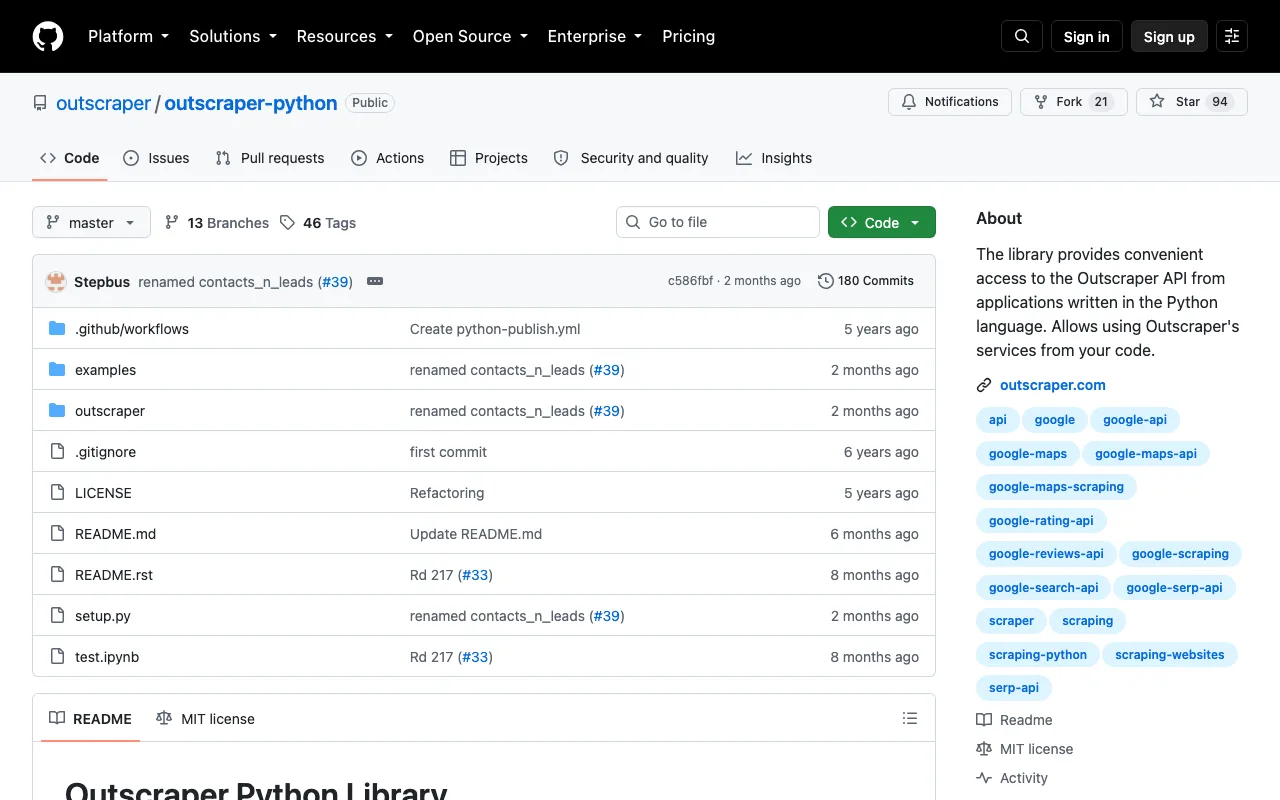
Outscraper covers more Google surfaces than any other tool here, not just Maps listings.
Its open source Python library documents services for Maps places, reviews, photos and directions, plus Google Search, Search News, Play reviews and an emails and contacts endpoint.
Key features
- Google Maps places, reviews, photos and directions in one API
- Google Search and Google Search News endpoints
- Google Play reviews
- Emails and contacts extraction from domains
- Official Python library under an MIT licence
- API key issued from your account dashboard
Why it made the list
If your project needs reviews, photos and search data alongside the listing itself, consolidating on one vendor beats stitching three together.
Pros
- Widest set of Google data sources on this list
- Maintained official client libraries
- Reviews and photos are first-class endpoints rather than add-ons
- Emails and contacts enrichment is built in
Cons
- Pricing is not readable without visiting the site directly
- The public site blocks automated access, which slows evaluation
- API-first design means non-developers will need help getting started
Visit Outscraper. Pricing: See vendor for current pricing.
5. Scrap.io
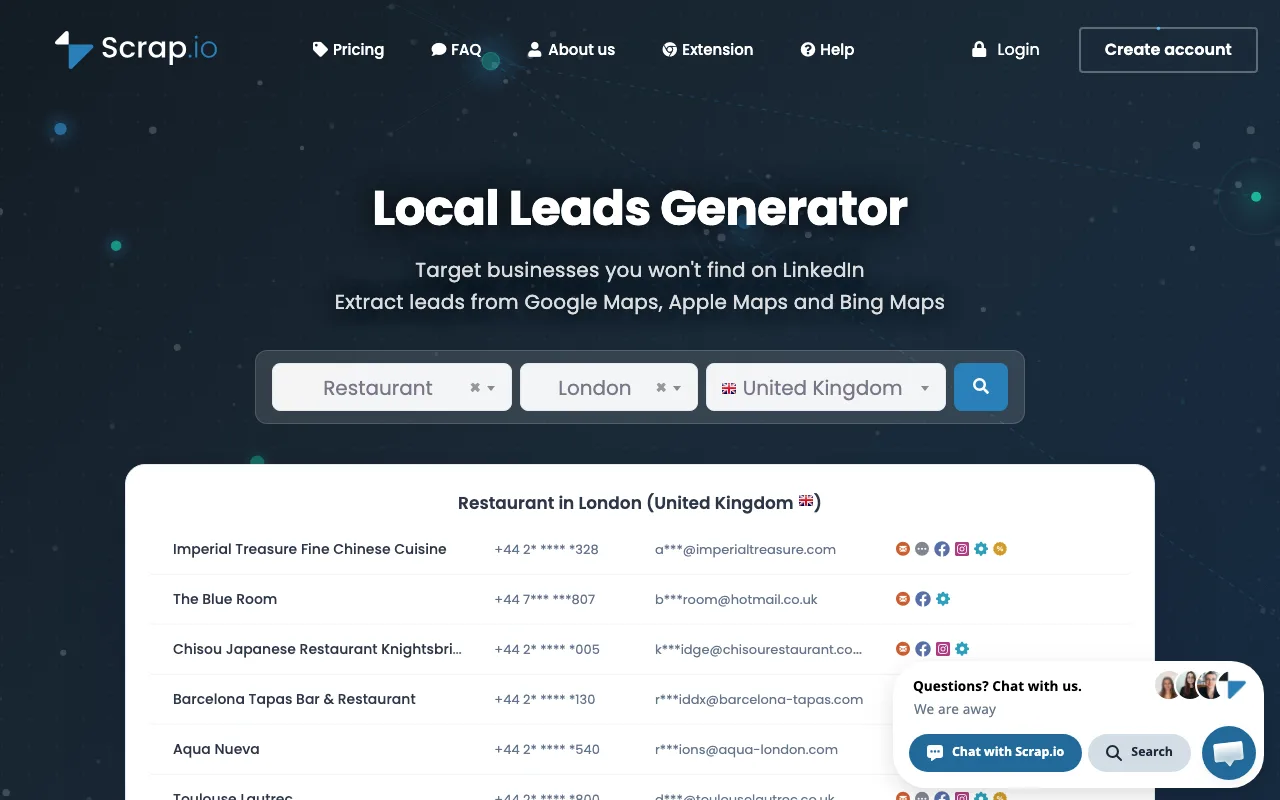
Scrap.io is built specifically for local lead generation rather than general scraping.
It positions itself as a “Local Leads Generator” and pulls from Apple Maps and Bing Maps as well as Google Maps.
Key features
- Basic at $35 a month yearly or $49 monthly, with 10,000 export credits
- Professional at $69 yearly or $99 monthly, with 20,000 credits
- Agency at $139 yearly or $199 monthly, with 40,000 credits
- Company at $350 yearly or $499 monthly, with 100,000 credits
- Search scope widens by tier, from a single city up to a whole country
- Company tier supports polygon search up to 1,000,000 square kilometres
Why it made the list
The territory model matches how agencies actually sell, which is by city or region rather than by record count.
Pros
- Purpose-built for local lead generation
- Covers Apple Maps and Bing Maps as well as Google
- Predictable monthly credits rather than metered billing
- Yearly billing cuts roughly 30 percent off the monthly price
Cons
- Lower tiers restrict you to city-level searches only
- Credit allowances are modest next to metered rivals
- No free tier is advertised on the pricing page
Visit Scrap.io. Pricing: From $35 a month billed yearly, or $49 monthly, for 10,000 export credits.
6. Lobstr.io
Lobstr uses the simplest pricing model here, where one credit equals one unique result.
That makes the monthly bill trivial to forecast, because you are never charged twice for the same business.
Key features
- Free plan with 100 credits and limited export
- Starter at $20 a month for 10,000 credits with unlimited export
- Pro at $100 a month for 100,000 credits
- Team at $500 a month for 1,000,000 credits
- Yearly billing shows a 20 percent discount
- Deduplication is built into the pricing, since credits count unique results only
Why it made the list
Paying for unique results rather than raw requests removes the usual guesswork from budgeting a scrape.
Pros
- One credit equals one unique result, so no double billing
- Cheapest entry paid tier here at $20 a month
- Scheduling and no-code runs included
- 20 percent off for yearly billing
Cons
- Free tier caps exports at 30 rows per request
- Free tier keeps data for only 7 days
- Premium scrapers are locked behind paid plans
Visit Lobstr.io. Pricing: Free for 100 credits, then $20, $100 or $500 a month.
7. Scrapingdog
Scrapingdog treats Google Maps as one endpoint inside a broader scraping API.
Its Google Maps API costs 5 credits per request, and failed requests are never charged.
Key features
- Free tier with 200 credits and no card required
- LITE at $40 a month for 200,000 credits
- STANDARD at $90 a month, PRO at $200 a month for 3,000,000 credits
- PREMIUM at $350 and BUSINESS at $500 a month
- Google Maps API billed at 5 credits per request
- Proxy rotation and browser handling are managed for you
Why it made the list
If you already scrape search results or e-commerce pages, adding Maps to an existing credit pool is cheaper than onboarding a second vendor.
Pros
- One credit pool across many different scraping targets
- Failed requests never charged
- Proxies and browsers are handled for you
- Free tier needs no card
Cons
- Credit maths is an extra step, since Maps costs 5 credits per call
- Built for developers, so there is no visual builder
- Maps is one product among many rather than the focus
Visit Scrapingdog. Pricing: Free for 200 credits, then $40 to $500 a month, with Maps costing 5 credits per request.
8. Octoparse
Octoparse is a general no-code scraper with a point-and-click builder, and Maps is one of its templates.
Its free plan is unusually usable, allowing 10 scraping tasks and up to 50,000 rows of export a month.
Key features
- Free forever plan with 10 tasks, 1 device and local extraction
- Free plan exports up to 50,000 rows a month
- Standard from $69 a month with 100 tasks and 3 concurrent cloud processes
- Professional at $249 a month with 250 tasks and 20 concurrent cloud processes
- Annual billing saves 16 percent
- 5-day money-back guarantee on paid plans
Why it made the list
It is the gentlest entry point for someone who has never written a line of code, and the free export allowance is the largest here.
Pros
- Genuinely useful free tier at 50,000 rows a month
- Point-and-click builder needs no code
- Cloud runs free your own machine on paid plans
- 5-day money-back guarantee
Cons
- Not specialised for Maps, so fields need configuring
- Cloud concurrency is limited to 3 processes on Standard
- The jump from Standard to Professional is steep at $249
Visit Octoparse. Pricing: Free forever for 10 tasks, then from $69 a month.
9. PhantomBuster
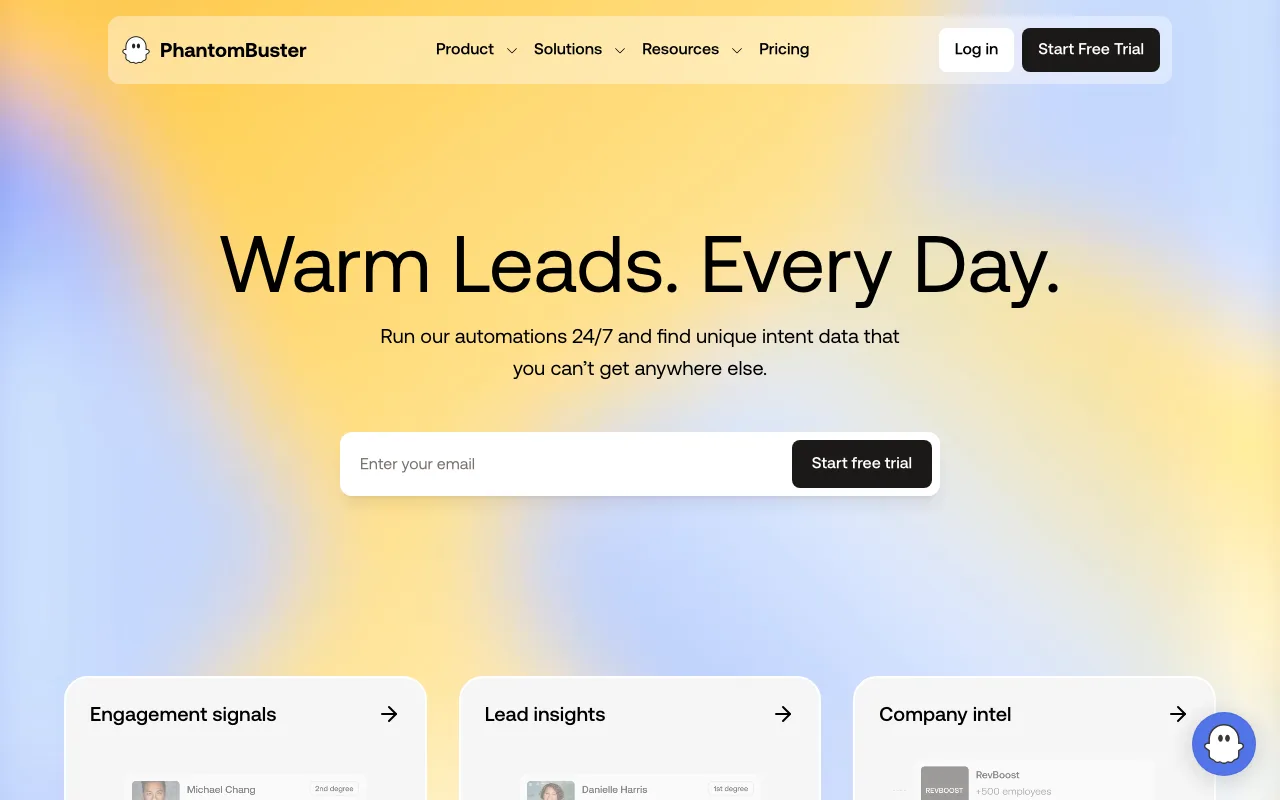
PhantomBuster is an automation platform first and a scraper second.
Its value is running extraction and follow-up as one scheduled chain rather than as separate jobs.
Key features
- Automations run on a schedule around the clock
- Maps extraction is one step in a longer workflow
- Chains into enrichment and outreach sequences
- Large library of prebuilt automations across platforms
- Cloud hosted, so nothing runs on your own machine
- Free trial available on the site
Why it made the list
It earns a place because scraping is rarely the goal, and this is the tool that carries a list straight into contact.
Pros
- Turns extraction and outreach into one scheduled pipeline
- Large library of prebuilt automations
- No local install or maintenance
- Useful well beyond Google Maps
Cons
- Pricing is not readable without visiting the site directly
- Depth of Maps data is thinner than dedicated scrapers
- Automation platform pricing gets expensive as you add slots
Visit PhantomBuster. Pricing: See vendor for current pricing.
Google Maps scraper pricing compared
Two vendors on this list do not publish a price that can be read without visiting them directly. Those rows say so rather than carrying an invented number.
| Tool | Free tier | Entry paid plan | Volume pricing |
|---|---|---|---|
| Apify | $5 usage credit monthly | Starter $29 a month | $1.50 per 1,000 places |
| Bright Data | 5,000 records monthly | Pay as you go | $1.50 per 1,000, or $499 a month for 384,000 |
| omkarcloud (Botasaurus) | Unlimited self-hosted, 200 searches hosted | $16 a month | $48 a month unlimited |
| Outscraper | See vendor | See vendor | See vendor |
| Scrap.io | None advertised | $35 a month yearly, $49 monthly | $350 a month yearly for 100,000 credits |
| Lobstr.io | 100 credits | $20 a month for 10,000 credits | $500 a month for 1,000,000 credits |
| Scrapingdog | 200 credits | $40 a month for 200,000 credits | $500 a month, Maps at 5 credits per request |
| Octoparse | 50,000 rows monthly | $69 a month | $249 a month for 250 tasks |
| PhantomBuster | Free trial | See vendor | See vendor |
What the price tags hide
Per-record pricing makes these tools look comparable when they are not. Three costs sit outside the headline rate.
Cost per usable record is the number that matters
A Maps listing is not a lead. Plenty of listings carry no email address and some carry no website either, so a raw record count overstates what you can actually contact.
Work out your own ratio on a small sample first, then divide the plan price by contactable records rather than total records. That single calculation reorders this list for most buyers.
Business data decays, so budget for the second scrape
Businesses close, move, rebrand and change numbers continuously. A list scraped once is a depreciating asset, not a permanent one.
Price your chosen tool across a year of refreshes rather than a single pull. Metered tools like Apify and Bright Data suit occasional refreshes, while credit subscriptions like Scrap.io and Lobstr suit a steady monthly cadence.
Collecting personal data brings duties with it
Business names, addresses and categories are ordinary business data. Named contacts and personal email addresses are personal data, and in the UK and EU that brings UK GDPR and GDPR obligations regardless of how the data was gathered.
The tools that enrich emails are the ones that move you into that territory. Decide whether you need contact-level data before you pay for it, and take your own legal advice on how you use it.
Throughput is set by blocking, not by your plan
Google rate limits aggressively, so the practical ceiling is proxy quality and concurrency rather than the number on your invoice.
Hosted tools absorb that problem for you. Self-hosting the MIT licensed option saves the per-record fee and hands you the blocking problem in exchange.
Frequently asked questions
What is the best Google Maps scraper?
For most people it is the Apify Google Maps Scraper, at $1.50 per 1,000 scraped places. It has the largest verified user base of the tools reviewed here, at 34,603 monthly users and a 4.71 out of 5 rating, and it extracts unusually deep fields including popular times and live occupancy.
Is there a free Google Maps scraper?
Yes. The Google Maps Scraper by omkarcloud is MIT licensed and free to self-host, and it extracts more than 50 data points per business. Bright Data also gives 5,000 records a month free, and Octoparse allows up to 50,000 rows of export a month on its free plan.
How much does Google Maps scraping cost?
Metered tools start around $1.50 per 1,000 records, which puts 10,000 businesses at roughly $15. Subscription tools start at $20 a month with Lobstr.io, $35 a month with Scrap.io billed yearly, and $69 a month with Octoparse. Self-hosting an open source scraper costs only your own compute.
Is it legal to scrape Google Maps?
Scraping publicly visible business information is treated differently from collecting personal data, and it is also governed by Google terms of service. Business names, addresses and categories are ordinary business data, while named contacts and personal email addresses are personal data and bring UK GDPR and GDPR duties. Take your own legal advice for your jurisdiction and use case.
What data can you extract from Google Maps?
Typical fields include business name, category, place ID, address, coordinates, phone number, website, rating, review count and opening hours. Deeper tools add the review distribution, individual reviews, photos, price bracket, popular times and live occupancy. Email addresses are usually an enrichment step rather than part of the listing itself.
Which Google Maps scraper is best for lead generation?
Scrap.io is built specifically for it, selling by territory from $35 a month billed yearly and covering Apple Maps and Bing Maps alongside Google. PhantomBuster suits you better if you want extraction and outreach running as a single automated chain.
Do I need coding skills to scrape Google Maps?
No. Octoparse offers a point-and-click builder, Scrap.io and Lobstr.io are no-code by design, and the omkarcloud scraper ships as a desktop app. Apify, Bright Data and Scrapingdog are friendlier if you are comfortable with an API.
